Midhat Jasic, PhD
Professor Emeritus, Nutrition & Food Science

The Science of PureNADH
NADH has a defined role in cellular energy metabolism. That does not automatically prove what an oral supplement will do. Follow the evidence from the real molecular structure to electron transfer, formulation, and product verification.
Verified NADH molecular structure · PubChem CID 439153 · Drag to rotate
01 — The molecule
NADH is the reduced form of NAD⁺, or nicotinamide adenine dinucleotide, a coenzyme used in redox reactions throughout living cells.
Its nicotinamide ring carries a hydride equivalent: two electrons and one proton. That electron-carrying state is what distinguishes NADH from NAD⁺.
This is established cell biology. It is not, by itself, evidence of what supplemental NADH does after ingestion.
02 — The mechanism
In the mitochondrial matrix, NADH transfers a pair of electrons to Complex I and is oxidized back to NAD⁺.
Those electrons continue through the respiratory chain. The free energy released during that transfer supports proton pumping across the inner mitochondrial membrane.
When protons flow back through ATP synthase, the enzyme uses that electrochemical gradient to form ATP from ADP and phosphate.
Simplified physiology of mitochondrial NADH oxidation. This animation does not depict the journey or effect of supplemental NADH.
Step 1: NADH donates two electrons to Complex I.
Interactive schematic · NADH oxidation inside a mitochondrion. Not a depiction of the supplemental product.
Biochemistry establishes what NADH does inside cells. It does not establish that swallowed NADH remains intact, reaches circulation, enters cells, changes mitochondrial NADH, or improves how a person feels.
Those are separate questions requiring separate evidence.
Established
Requires product testing
Requires human evidence
We keep these evidence levels separate throughout this page.
04 — Condition-sensitive chemistry
The reduced form can oxidize to NAD⁺ and undergo other changes under unfavorable conditions. In laboratory systems, NADH stability is influenced by factors including pH, temperature, buffer composition, and UV exposure.
This does not mean every molecule is destroyed instantly. It means formulation, packaging, storage, and analytical verification matter.
Published stability research describes NADH under specific laboratory conditions. It is not a test of the finished PureNADH product.
05 — Formulation design
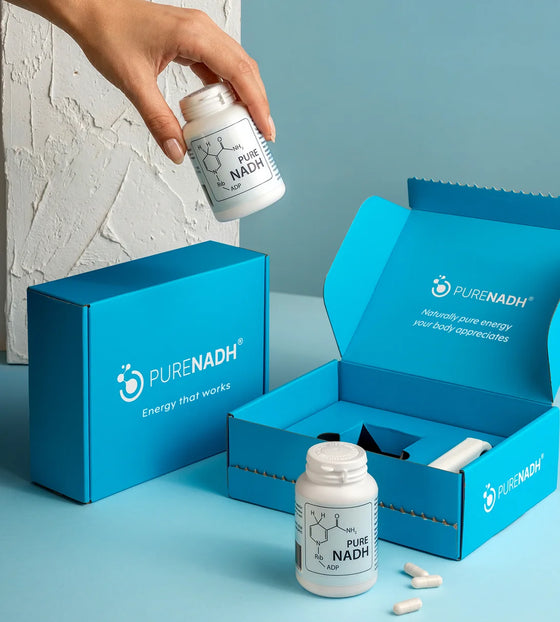
PureNADH combines a freeze-dried NADH ingredient, a cyclodextrin-based formulation, and an acid-resistant capsule.
These choices are intended to address different formulation checkpoints. Design explains the intent; finished-product testing must establish performance.
Formulation concept · not to scale · design intent, not performance proof
Lyophilization removes water during processing to create a dry NADH format.
PureNADH uses a cyclodextrin-based formulation as a component of the finished product.
The capsule is designed to delay opening under acidic conditions and release its contents later in the digestive process.
A U.S. patent application is pending covering aspects of our formulation.
Patent-pending status describes a filed application. It does not establish product efficacy, safety, stability, or absorption.
06 — Product evidence
A badge or adjective is not enough. Each product claim should point to a method, sample, result, date, and responsible laboratory.
Only reports testing the finished PureNADH product should be presented as PureNADH-specific proof.
Does the finished capsule contain the stated form and amount of NADH?
In progressHow much NADH remains through the stated shelf life and storage conditions?
In progressHow does the finished capsule release under defined gastric and intestinal conditions?
In progressWhat was tested, on which lot, by which laboratory, and against which specification?
Not yet establishedWhich facility, standard, certifier, scope, and validity period apply?
Not yet establishedPatent status does not establish clinical efficacy. Facility certification does not establish human outcomes.
07 — From product to person
The Supplement Facts panel lists 100 mg of NADH per capsule. That number does not by itself establish retained shelf-life potency, release, absorption, an optimal dose, or a greater effect.
Published oral NADH studies vary in dose, formulation, population, duration, and outcome. Research on another formulation cannot be treated as a trial of PureNADH.
Every checkpoint needs its own evidence. This is a sequence of questions, not a completeness status.
Every cited study must state whether it investigated:
If PureNADH has not been studied for an outcome, this page says so.
International Expertise
Interdisciplinary expertise with international recognition in nutrition and pharmacy is a core part of the PureNADH team. It enables us to develop products like PureNADH to the highest quality standards, setting new benchmarks.
Professor Emeritus, Nutrition & Food Science

Pharmaceutical
Formulation Lead

Neuroscientist
& Cell Biologist
Quality is in our DNA
Made in an FDA-registered, GMP-certified facility.
Every batch is independently third-party tested for purity and potency
Dietary supplements often have an image problem for good reason: nutrient density, stability, or bioavailability are frequently unreliable. The reason: usually costs for quality assurance and profit orientation.
PureNADH stands for uncompromising quality: highest purity, stability, and bioavailability, at fair prices. For noticeable effects!
Each batch is tested in certified laboratories for heavy metals, contaminants, and microorganisms. Our GMP-certified production facility meets ISO 22000 and HACCP standards, certified by TÜV Thüringen and DakkS.

10 — The evidence at a glance
Established
NADH is the reduced form of NAD⁺. It transfers electrons into cellular respiration, while ATP is produced downstream using an electrochemical proton gradient.
Formulated
PureNADH is labeled to contain 100 mg of NADH and uses freeze-drying, a cyclodextrin-based formulation, and an acid-resistant capsule.
Product-dependent
Retained shelf-life potency, dissolution behavior, systemic exposure, and human outcomes each require their own relevant evidence.
Review the complete Supplement Facts, other ingredients, directions, warnings, price, and return terms before deciding.
100 mg labeled NADH per capsule · Full ingredients and directions on the product page
PureNADH is a dietary supplement, not a treatment. No outcome is guaranteed. Follow the label. If you are pregnant, nursing, managing a medical condition, taking medication, or are unsure whether the product is appropriate for you, consult a qualified healthcare professional before use.
This statement has not been evaluated by the Food and Drug Administration. This product is not intended to diagnose, treat, cure, or prevent any disease.
Mechanism references explain endogenous NADH biology. They are not evidence of PureNADH absorption or product outcomes.